Frizerly Alternatives Pricing Guide: What You Will Actually Pay
Some platforms raise prices quietly while your credit balance shrinks faster than expected. If you are comparing content tools, the sticker price rarely matches the final invoice. Knowing what each plan actually delivers matters more than the headline number.
This guide breaks down Autoblogging.ai pricing from the $19 Starter tier to the $999 Enterprise plan, including what credits buy, how rollover works, and which features come with each tier. By the end, you will know which plan fits your output and whether the cost makes sense for your workflow.
What Is Autoblogging.ai? A Content Automation Platform Built for Scale
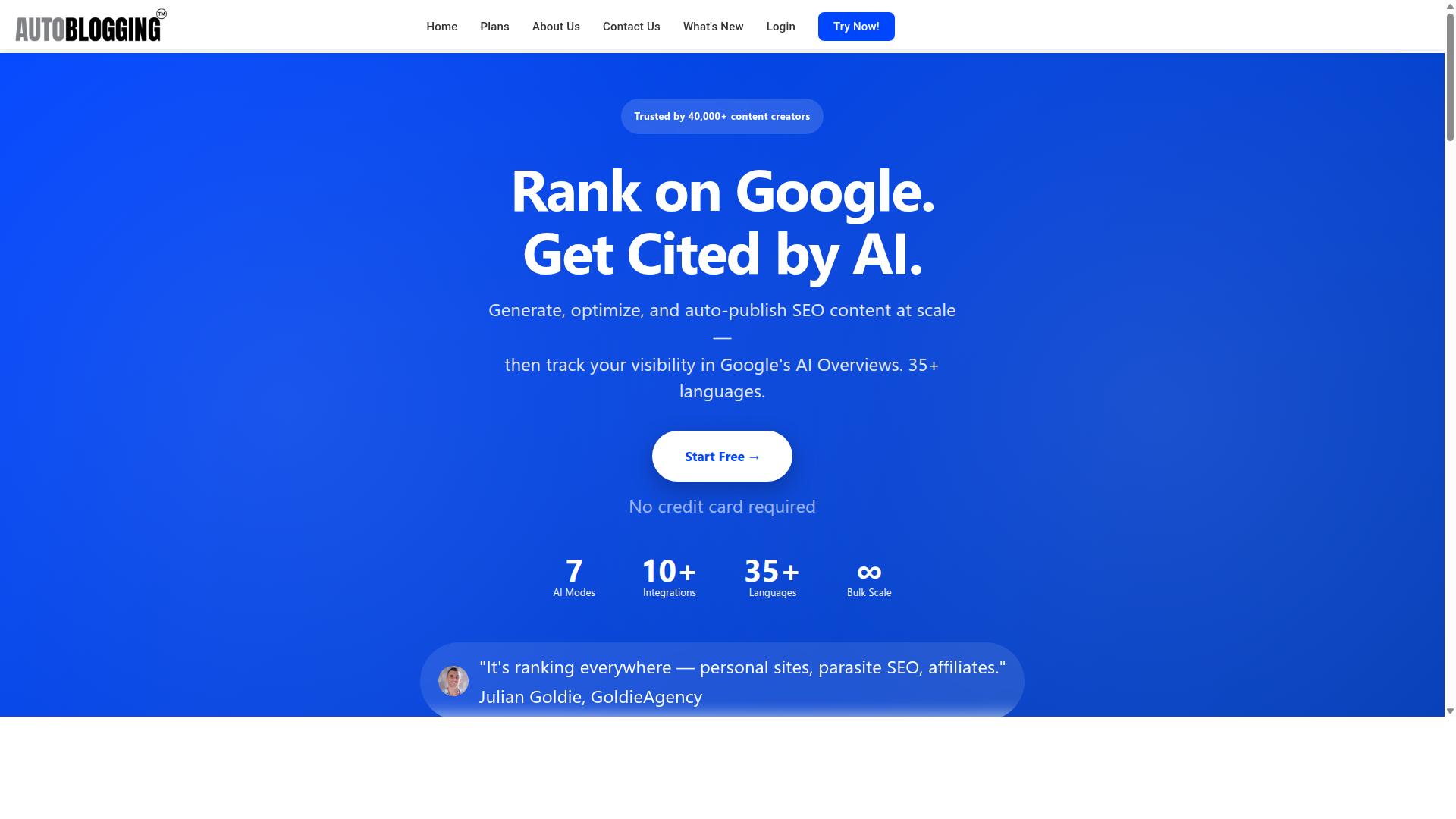
Autoblogging.ai is an AI-powered content automation platform that generates articles at scale, designed for bloggers, agencies, and SEO professionals who need to produce high volumes of optimized content without sacrificing quality. It is a product of Digimetriq.com, built on the mission of helping bloggers, website owners, and agencies save time while improving their online presence through cutting-edge technology.
The platform's core purpose is straightforward: cut down content costs and scale production efficiently. It aims to enable human counterparts within existing SOPs by delivering the first draft, while Digimetriq's longer-term goal is to replace human counterparts entirely.
The track record backs up the ambition. Autoblogging.ai is trusted by over 40,000 content creators and has generated more than 1 million articles. It is available globally and differentiates itself through multiple AI modes, language support, and integrations.
For anyone weighing Frizerly alternatives, understanding what Autoblogging.ai actually is matters before comparing subscription fees, monthly billing, or annual plans. The sections below break down who it serves and how that shapes the real cost of ownership.
Who It Serves: Bloggers, Agencies, SEO Pros and Affiliate Marketers
The platform is built for a wide range of content creators, including individual bloggers, marketing agencies, SEO professionals, and affiliate marketers who manage multiple websites. Each group uses it differently, and that difference directly affects which pricing tier or plan structure makes sense.
A solo blogger might produce 50 articles a month across a personal site and a niche project. For that user, usage-based pricing or a mid-tier monthly plan usually beats per-user pricing, since there is only one seat to fill.
An agency owner handling 20 client websites faces a different math. Seat-based pricing and volume discounts become the deciding factors, because onboarding charges and setup fees multiply quickly when every client account needs its own workflow.
The platform supports a broad spread of site types:
- Personal sites and blogs
- Parasite SEO campaigns
- Affiliate sites
- Client websites
- Portfolio sites
- Local sites
SEO professionals focused on parasite SEO or portfolio sites tend to care most about cost-effectiveness per article and how quickly content moves from draft to publish. Affiliate marketers running niche sites weigh the same output against total cost of ownership, since thin margins make hidden costs and add-on pricing far more painful than they are for agencies with retainer budgets.
That range of use cases is why Autoblogging.ai appears so often in Frizerly alternatives comparisons. A tool that serves a solo blogger and a 20-client agency from the same platform has to price flexibly, and understanding which segment you fall into is the first step in predicting what you will actually pay.
What You Will Actually Pay With Autoblogging.ai
Understanding the true cost of Autoblogging.ai means looking beyond the headline price to see how credits, modes, and billing cycles affect your monthly outlay. Autoblogging.ai uses a credit-based, tiered pricing model rather than per-user billing, so the amount you pay depends on how many articles you generate, not how many people log in.
The platform offers both monthly and annual billing options, giving you flexibility to match spend to your content needs. Every tier includes credits rollover, and new accounts receive 10 free credits per month with no credit card required to start.
Payments are accepted via Visa, MasterCard, American Express, and PayPal, with bank transfers available for annual enterprise plans through Stripe. You can cancel anytime, which keeps the commitment low while you evaluate fit.
Monthly Plans: From $19 Starter to $999 Enterprise
Autoblogging.ai offers six monthly plans, starting at $19 for 40 credits and scaling up to $999 for 5,000 credits, catering to everyone from solo bloggers to large agencies. The full lineup gives you a clear ladder to climb as your content output grows.
| Plan | Monthly Price | Credits |
|---|---|---|
| Starter | $19 | 40 |
| Regular | $49 | 120 |
| Standard | $99 | 300 |
| Gold | $179 | 600 |
| Premium | $249 | 1,000 |
| Enterprise | $999 | 5,000 |
Credits are used to generate articles, and different modes consume different amounts. That means your effective cost per article depends on which mode you choose, so the credit count matters more than the raw plan price when you do budget planning.
Pricing is not per-user but per-account, which makes the platform cost-effective for teams. A single subscription can support multiple collaborators without seat-based pricing inflating your bill. All plans include core features and support, so upgrading is about volume, not unlocking basic functionality.
Additional credits can be purchased if you run short before renewal, and unused credits roll over. That combination gives you a buffer against uneven publishing schedules without forcing an immediate plan jump. For readers comparing Frizerly alternatives, this transparent tier structure makes it easy to estimate total cost of ownership before committing.
Annual Plans and the Real Savings Behind Yearly Billing
Opting for annual billing with Autoblogging.ai can yield significant savings compared to paying monthly. The exact annual rates are published, so you can calculate your savings precisely rather than guessing at a vague discount.
| Plan | Monthly Billing | Annual Billing (per month) | Annual Total |
|---|---|---|---|
| Starter | $19 | $12 | $148 |
| Regular | $49 | $32 | $382 |
| Standard | $99 | $64 | $772 |
| Gold | $179 | $116 | $1,396 |
| Premium | $249 | $162 | $1,942 |
| Enterprise | $999 | $649 | $7,792 |
The savings are real and measurable. On the Starter plan, paying monthly would cost $228 per year, while annual billing drops that to $148. That is a meaningful reduction in your total cost of ownership for anyone publishing consistently.
Annual plans carry the same credit allocations and features as their monthly counterparts. You are not trading functionality for a discount, only committing to a longer billing cycle. Credits rollover applies here too, so unused volume is not lost at year end.
Contract terms stay flexible. There is no long-term lock-in, and you can cancel anytime. Bank transfers are available for annual enterprise plans via Stripe, which suits larger organizations that prefer invoiced payment processing over card charges.
For long-term users, annual billing is the stronger value proposition. If your content roadmap spans several months or more, the yearly rate lowers your effective monthly cost and simplifies budget planning. It is the clearest path to cost-effectiveness for anyone treating content as an ongoing investment rather than a one-off experiment.
What Your Credits Actually Buy: Modes, Output and Rollover
Credits are the currency of Autoblogging.ai, and understanding how they translate into articles across different modes is key to evaluating the platform's true value.
Every article you generate draws from a credit balance, and the number of credits required depends on the mode you choose. Quick Mode keeps costs low for everyday posts, while Godlike Mode consumes more credits because it performs deeper analysis before writing. Bulk Generation sits somewhere in between, scaling output across hundreds of articles at once.
What makes this system flexible is that credits roll over month to month. If you do not use your full allocation in a slow month, those credits stay available for a heavier publishing push later. For anyone comparing Frizerly alternatives on total cost of ownership, this rollover policy directly affects how far your subscription fees stretch.
Quick Mode, Godlike Mode, Bulk Generation and Beyond
Autoblogging.ai offers multiple generation modes, each consuming different credit amounts and delivering varying levels of depth and optimization.
Quick Mode is the entry point. It is free and covers single article generation plus a wizard option, making it suitable for basic content needs or testing the platform before committing credits. It keeps your usage-based costs near zero for simple posts.
Godlike Mode is the premium tier of generation. It runs SERP competitor analysis, pulls in LSI keywords, and performs knowledge graph extraction to produce highly optimized articles. Because of that extra work, it costs more credits per article than Quick Mode. For competitive keywords where ranking matters, that higher per-article spend often delivers better value proposition than publishing thin content more often.
Bulk Generation handles mass production, supporting up to 500 articles via CSV upload. It is built for agencies and high-volume publishers who need consistent output without manual, one-by-one generation.
Beyond these, the platform ships 10+ AI modes in total, including specialized options like News Mode with Google News integration and Amazon Reviews Mode. That range means you are not locked into a single content format. You can match the mode to the job, from quick blog posts to review content to news-driven articles, and scale up or down as your budget allows.
Credits That Roll Over and a Human Proofreader on Every Plan
Unlike many SaaS platforms, Autoblogging.ai allows unused credits to roll over month to month, ensuring you never lose value for what you've paid.
That matters for budget planning. If your publishing schedule is uneven, you can bank credits during quiet periods and spend them on a larger project later, rather than watching them expire. There is no lock-in penalty for a slow month, which softens the effective cost of your subscription fees over a full year.
Every plan also includes a human proofreader, not just an AI proofreader. That adds a quality assurance layer most self-serve tools do not offer, and it is a meaningful part of the ROI calculation. For agencies producing content at volume, consistent editorial quality reduces rework and protects client relationships, which is often where the real hidden costs of cheaper alternatives show up.
Ongoing support strengthens the value further. Autoblogging.ai provides 24/7 support and ships new features weekly, so the platform you pay for today keeps expanding. Combined with rollover credits and human review on every tier, the total cost of ownership compares favorably against alternatives that charge extra for add-ons or cap your usage.
Key Features That Justify the Price
Beyond basic article generation, Autoblogging.ai packs advanced features that directly impact SEO performance and workflow efficiency, making the subscription cost easier to justify.
Where many tools charge extra for the capabilities that matter most, Autoblogging.ai includes its premium features in every plan. That approach to pricing matters when you are comparing alternatives and calculating your total cost of ownership.
The features below are the ones that separate a basic content generator from a complete publishing system. They also explain why Autoblogging.ai's pricing holds up well in a competitor comparison, since you are not paying add-on pricing for each capability separately.
SERP Competitor Analysis, Semantic SEO and 35+ Integrations
Autoblogging.ai's Godlike Mode performs SERP competitor analysis, extracts LSI keywords and knowledge graph entities, and integrates with over 35 tools to streamline your content pipeline.
SERP competitor analysis means the system examines the pages already ranking for your target keyword. It looks for the topics, subtopics, and terms those pages cover, then uses that picture to shape the article it produces. The goal is content built around what search engines already reward for that query.
Semantic SEO features go a step further. LSI keywords and knowledge graph extraction help the article cover related concepts and entities, not just the main term. This supports topical depth, which is a common factor in how pages earn visibility.
The platform also includes a Semantic SEO Analysis tool with a 21-point audit, plus a Snippet Optimizer, Topical Maps, Fan Out Queries, and an AI Proofreader. Each of these supports the same objective: stronger on-page relevance without manual research for every post.
Integrations extend the value further. Autoblogging.ai connects with:
- WordPress, including a plugin and scheduled auto-posting
- Zapier and n8n for workflow automation
- Web 2.0 platforms such as Medium, Dev.to, Hashnode, Telegraph, and Tumblr
- Multi-platform publishing to Shopify, Wix, Webflow, Blogger, and Ghost
- An API for custom setups
These capabilities are part of the standard pricing, not premium add-ons. For buyers weighing subscription fees against value, that inclusion is central to the cost-effectiveness of the plan.
One-Click WordPress Publishing in 35+ Languages
Publishing directly to WordPress from Autoblogging.ai takes one click, and with support for over 35 languages, you can scale content globally without manual uploading.
The WordPress integration supports unlimited sites. You connect your site, generate articles, and publish them as drafts or live posts. Scheduled auto-posting means you can queue content to go out on your own timeline rather than pushing each piece by hand.
Language support changes what is possible for anyone running more than one site. A blogger or agency can build multilingual content strategies from a single workflow instead of rewriting or outsourcing each language. That reduces both the hours spent on manual work and the errors that creep in when content is copied between platforms.
For teams managing several properties, this is where the value proposition becomes concrete. Publishing across many sites normally means repetitive uploading, formatting checks, and scheduling. Automating that step frees time for strategy, outreach, and the work that actually grows traffic.
Paid plans also include the Content Repurposer, AI Infographics, Outreach Prospects, and a Human Proofreader. Done For You packages are available for those who want the work handled entirely. When you map these features against monthly billing, the per-site cost drops as you add properties, which is a meaningful factor in budget planning and overall ROI.
Trust Signals: 40,000+ Users, 1M+ Articles and a 4.9 Rating
With over 40,000 content creators, more than 1 million articles generated, and an average rating of 4.9, Autoblogging.ai has a proven track record that reinforces its pricing. These are not marketing slogans. They reflect a large, active user base that keeps renewing subscriptions month after month.
For anyone weighing total cost of ownership, that scale matters. A platform with tens of thousands of paying users has survived real-world scrutiny, which is a stronger signal than any single feature list. It also suggests the value proposition holds up beyond the first billing cycle.
Credits rollover and a human proofreader included in all plans further support the cost-effectiveness argument. When comparing Frizerly alternatives, track record and retention often predict satisfaction better than a low headline price.
What Named Industry Users Say About the Platform
Industry figures like Julian Goldie (GoldieAgency, 250k+ YouTube subscribers), James Dooley (FatRank, PromoSEO), and Bart Magera (MojoLinks) have publicly endorsed Autoblogging.ai for its efficiency and output quality. Their audiences follow them precisely because they test tools before recommending them.
Kyle Duncan, an SEO professional, and Dimitar Georgiev, CEO of IDEAMAX.EU, round out the named endorsements. Across these testimonials, three themes recur: time savings, cost-effectiveness, and ranking improvements. Those are the exact outcomes that determine whether a subscription fee pays for itself.
Why do these endorsements matter for a pricing guide? Because a tool that saves hours per week effectively lowers its own actual cost. If a plan replaces even a portion of outsourced writing, the monthly billing becomes easier to justify against budget planning targets.
Additional voices include Cagri Sarigoz (Founder, Cagri Sarigoz LLC) and Jacky Chou (Indexsy). Each works in a different corner of SEO and content marketing, which broadens the credibility of the praise beyond a single niche.
None of this replaces reading the numbers yourself. But when recognizable practitioners attach their names to a platform, it strengthens the case that the ROI is real rather than theoretical. That context should inform how you weigh subscription fees against cheaper, unproven options.
Who Gets the Most Value From Autoblogging.ai
The platform delivers the highest ROI for users who produce content at scale, such as agencies managing multiple clients, affiliate marketers running large niche sites, and SEO professionals executing parasite SEO campaigns. Autoblogging.ai serves bloggers, website owners, marketing agencies, content creators, and affiliate marketers across personal sites, client websites, portfolio sites, and local sites. The common thread is volume: the more content a user needs, the more the numbers tilt in their favor.
For agencies, the value proposition is straightforward. Content production is one of the largest recurring costs in any client retainer, and white-labeling articles at scale lets an agency serve more clients without proportional hiring. An agency producing 500 articles per month would save thousands compared to paying freelance writers per piece, while keeping delivery timelines predictable.
Affiliate marketers benefit differently. Large niche sites live or die on publishing pace, and quickly populating a site with optimized articles shortens the gap between launch and first commissions. SEO professionals running parasite SEO campaigns face the same math: volume and speed matter, and per-article costs drop sharply as credit packages grow.
Budget planning is where the tiered pricing becomes clear. On the Enterprise plan, 5,000 credits at $999 works out to $0.20 per article, a rate that is highly cost-effective for high-volume users. Solo bloggers who publish regularly can still benefit from the Starter plan, though the per-article cost is naturally higher at lower volumes.
Use this quick filter to see where you fit:
- Agencies: multiple client sites, ongoing retainers, and a need to cut production costs
- Affiliate marketers: large niche sites that need rapid content population
- SEO professionals: parasite SEO campaigns that depend on scale
- Solo bloggers: consistent publishers who want steady output on a smaller budget
The takeaway is simple: the more articles you need each month, the stronger the cost-effectiveness and ROI become. If your content demands are modest and occasional, a smaller plan fits. If content is central to how you earn, Autoblogging.ai is built for exactly that kind of operation.
Final Verdict: Is the Price Worth What You Actually Get?
Based on publicly available features and pricing, Autoblogging.ai emerges as a cost-effective solution for anyone serious about scaling content production. The platform's transparent pricing keeps budget planning simple. What you see on the pricing page is what you pay.
Credits that roll over give users breathing room. Instead of losing unused value at the end of a billing cycle, you can carry it forward and use it when your content needs spike. That flexibility matters for creators whose publishing schedules are not perfectly even month to month.
Advanced features come included rather than locked behind expensive add-on pricing. This matters when comparing total cost of ownership against alternatives. Hiring freelance writers typically costs far more per article, and stacking multiple AI tools with separate subscription fees adds up quickly.
For high-volume content creators, the ROI is clear. When you spread the cost across dozens or hundreds of articles, the per-article expense drops well below what traditional methods charge. Cost-effectiveness at scale is where the value proposition becomes hardest to ignore.
For low-volume users, the free Quick Mode or Starter plan offers a low-risk entry point. You can test the output quality and workflow before committing to a paid tier. That freemium-style approach removes the pressure of a large upfront commitment.
If you have questions about plans, billing, or which tier fits your needs, reach out directly:
- India office: 501, Trinity Orion, Vesu, Surat - 395007, Gujarat, India
- Phone or WhatsApp: +91 84605-06553 / +91-8460506553
- Email: [email protected]
- Skype: vibes.yb
- Support hours: 7:00-19:00 IST
- United Kingdom office: 2nd Flr, SEO Content Suite, 35 Water Ln, Wilmslow, Cheshire SK9 5AR
- UK phone: +44 1625 359056
You can also connect through the brand's Facebook, Twitter, and LinkedIn pages for updates and general inquiries. Reaching the team before you buy is a simple way to confirm which plan matches your content volume and budget.
The bottom line: Autoblogging.ai combines clear pricing, rollover credits, and included premium features with real human support you can contact. For anyone weighing Frizerly alternatives, the numbers favor this platform at nearly every volume level.
Frequently Asked Questions
How much does Autoblogging.ai actually cost compared to Frizerly?
Autoblogging.ai publishes its monthly plans in USD: Starter $19 (40 credits), Regular $49 (120 credits), Standard $99 (300 credits), Gold $179 (600 credits), Premium $249 (1,000 credits), and Enterprise $999 (5,000 credits), with annual plans billed yearly. Since competitor pricing changes often, check Frizerly's current pricing page directly rather than relying on second-hand figures. Comparing the two side by side on credits and features is the only way to know what you'll truly pay.
What is a credit, and how many articles will my plan actually produce?
Credits are the currency Autoblogging.ai uses across its AI modes, and different modes and article lengths can consume different amounts. The exact credit-to-article ratio depends on the mode and settings you choose, so the most reliable approach is to test your typical article type on a plan and track usage. Credits also roll over, so unused balance isn't automatically lost at the end of a billing cycle.
Are there hidden costs beyond the subscription price?
Autoblogging.ai's pricing is published openly as monthly and annual plans, and a human proofreader is included in annual plans, so there's no separate add-on fee for that. As with any SaaS purchase, factor in currency conversion or payment processing fees your bank may charge if you're paying from outside the US. If you need a specific volume or feature, confirm it with support before upgrading rather than assuming an extra charge exists.
Is there a free option if I just want to try it before paying?
Yes - Quick Mode is free and available as both a single and a wizard option, which lets you generate content before committing to a paid plan. Paid plans start at $19/month for 40 credits and scale up to the $999/month Enterprise tier with 5,000 credits. Starting free and upgrading once you know your real monthly volume is the most accurate way to predict your actual cost.
Why do alternative pricing guides give such different numbers?
Most guides compare headline prices without accounting for credit allowances, rollover, or which modes are included, so the "cheapest" option often isn't the cheapest per usable article. Autoblogging.ai's structure is transparent - six monthly tiers from $19 to $999, plus annual billing - which makes it straightforward to calculate cost per credit. Always normalize competing tools to a cost-per-article basis before deciding.
What do I get for the price that cheaper alternatives may not include?
Autoblogging.ai includes 10+ AI modes, 35+ languages, 35+ integrations, credit rollover, and 24/7 support, with new features shipped weekly. It's trusted by 40,000+ content creators with a 4.9 average rating and 1M+ articles generated, and it's built by Digimetriq.com with founder Vaibhav Sharda leading development since 2022. Whether those extras justify the price depends on your workflow - if you need bulk generation or SERP-driven modes, they typically matter more than a lower headline rate.
Recommended Resources: